Most "cedar" in candles isn't cedar. Of the cedarwood essential oils used most heavily in the fragrance industry, the majority come from juniper trees — not from the genus Cedrus. This post is a breakdown of what cedar means as a material, what gets sold under the name, and what we use in Embers.
The Four True Cedars
Botanically, only four species qualify as cedars. They belong to the genus Cedrus, in the pine family Pinaceae:
Cedrus atlantica — Atlas cedar. Morocco and Algeria.
Cedrus libani — Lebanon cedar. Eastern Mediterranean.
Cedrus brevifolia — Cyprus cedar. Cyprus, Troodos mountains.
Cedrus deodara — Himalayan or Deodar cedar. Western Himalayas.
Anything sold as "cedar" outside that list is using the name commercially, not botanically.
What’s Actually Sold as Cedar in Fragrance
Three species dominate the cedarwood essential oil supply chain, and two of them are juniper:
Virginia cedarwood — Juniperus virginiana. A juniper native to the eastern United States, in the cypress family Cupressaceae. This is the most common cedarwood essential oil in fragrance, with US production exceeding 100,000 pounds per year, mostly distilled from sawmill byproducts. Soft, dry, pencil-shavings character.
Texas cedarwood — Juniperus mexicana (sometimes J. ashei). Also a juniper. Drier and smokier than Virginia cedarwood, with a higher thujopsene content that can crystallise at room temperature.
Atlas cedarwood — Cedrus atlantica. A true cedar, listed as Endangered on the IUCN Red List. Range-wide population declines of up to 75% are estimated to have occurred between 1940 and 1982, with further decline since the 1980s driven by drought, fires, and human exploitation.
The naming convention is industry-standard, not deceptive in itself. But most product labels don't tell you which species you're buying — only that there is "cedar" in the formulation. The same word can mean any of seven different trees from three different botanical families.
What We Use in Embers
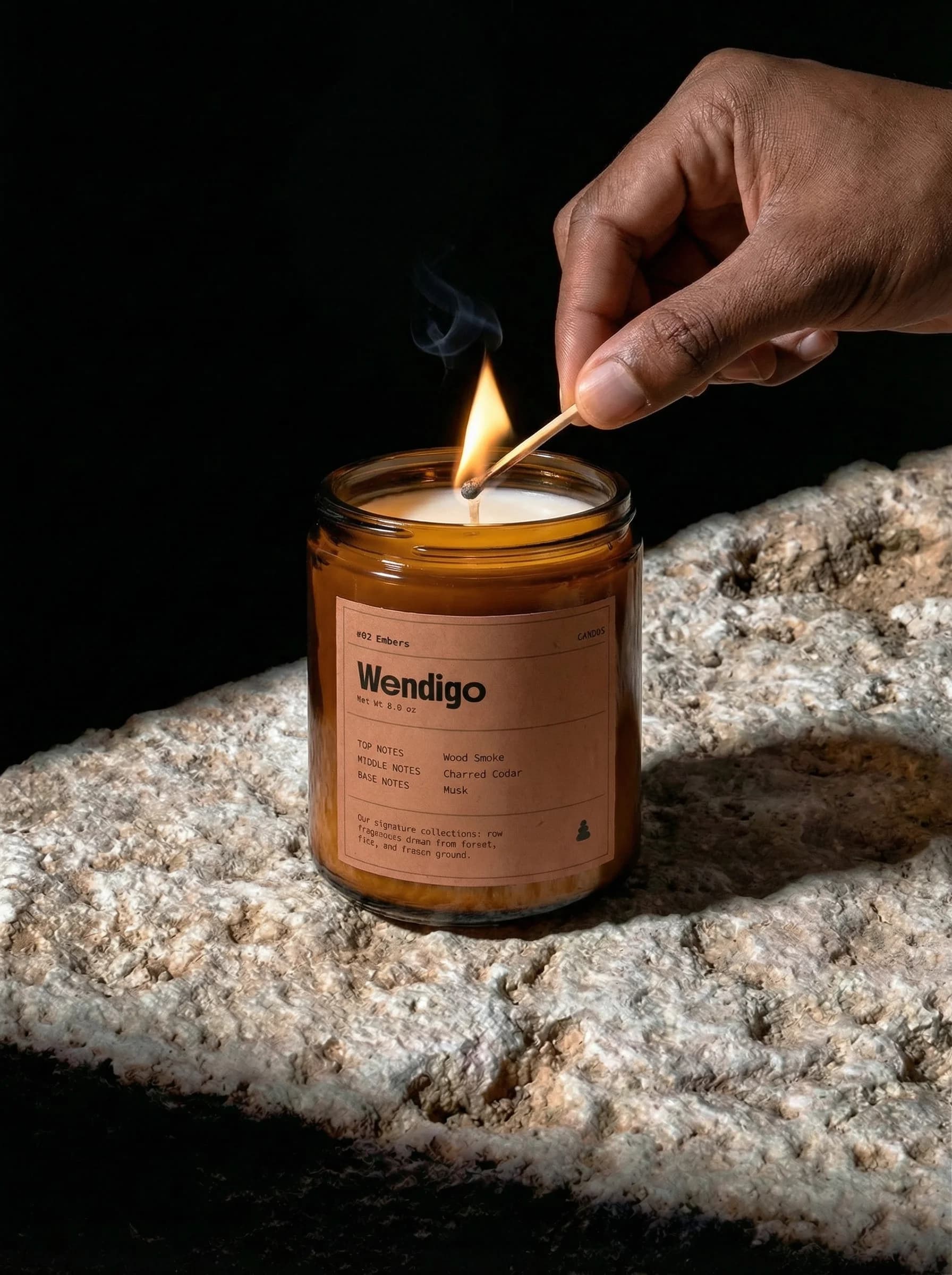
Embers uses Virginia cedarwood (Juniperus virginiana), steam-distilled from heartwood at mills in Virginia and North Carolina. The oil is a coproduct of the timber industry: the wood is felled for lumber, and the residual sawdust and offcuts are distilled rather than discarded. This means our cedar note rides on existing demand for the wood — it does not drive its own forestry pressure.
We do not use Atlas cedar. The species is endangered, and while certified-sustainable Atlas cedar does exist, supply is limited and demand pressure is meaningful. We have chosen not to add to it. If the industry moves toward Atlas cedar that is verifiably regenerative — replanted, monitored, and third-party certified — we will reassess.
For the smoky character in Embers, we use heat-treated J. virginiana alongside small percentages of synthesised cedrene derivatives. The latter are covered in a separate post on synthetics.
Why This Is on the Website
Most fragrance brands name a note ("cedar") without naming the species. The label is doing a lot of work — it can refer to a true cedar, a juniper, a thuja, or a cypress, with very different ecological footprints. Naming the species is the floor, not the ceiling, of fragrance transparency. We treat it as the minimum.
FAQ
Is the cedar in candles real cedar?
Usually not. The most common cedarwood essential oil in the fragrance industry is from Juniperus virginiana, which is botanically a juniper. True cedars in the genus Cedrus are less widely used commercially — in part because Atlas cedar, the most aromatic of the four true cedar species, is listed as Endangered on the IUCN Red List.
Is Virginia cedarwood sustainable?
The species (Juniperus virginiana) is not threatened. It is actually expanding aggressively across the eastern United States, where fire suppression has allowed it to colonise former grasslands. Virginia cedarwood essential oil is typically produced as a coproduct of the lumber industry — distilled from sawmill byproducts rather than from trees felled specifically for oil — which makes it lower-impact than oils whose primary use is the oil itself.
Why don’t you use Atlas cedar?
Cedrus atlantica is listed as Endangered on the IUCN Red List, with range-wide declines of up to 75% over the second half of the twentieth century, and further decline since. Certified-sustainable Atlas cedar exists, but the supply is limited and we have chosen not to add demand pressure to a species already in decline.
What is the difference between cedrol and cedryl acetate?
Cedrol is a sesquiterpene alcohol naturally present in cedarwood essential oils. Cedryl acetate is the synthesised acetate ester of cedrol, manufactured for fragrance applications where a different solubility, stability, or olfactive profile is needed. Cedrene, another major component, is commonly isolated from cedarwood oil and used as a precursor for synthetic sandalwood molecules such as Cedramber.
How can I tell if a brand’s cedar is what they say it is?
Look for the Latin binomial (e.g. Juniperus virginiana vs. Cedrus atlantica), country of origin, and ideally a certification — FSC for the wood, IFRA compliance for the oil. Brands that decline to disclose the species are most often using a juniper.
About the Name
Wendigo originates in oral traditions of Algonquian-speaking peoples — including the Ojibwe, Cree, and Innu — where the figure carries meanings related to ecological consequence and restraint. We use the name with awareness that those traditions are not ours to interpret, and our work focuses on applying a principle of restraint to material sourcing. For an introduction to how Indigenous resource ethics have been documented in academic literature, see Krech (1999) and Kimmerer (2013), cited above.
Sources
- Thomas, P. (2013). Cedrus atlantica. The IUCN Red List of Threatened Species 2013: e.T42303A2970716.
- Royal Botanic Garden Edinburgh. Cedrus atlantica, in Threatened Conifers of the World.
- EUFORGEN (2024). Cedrus atlantica species profile. European Forest Genetic Resources Programme.
- National Toxicology Program (2016). Technical Report on the Toxicity Studies of Cedarwood Oil (Virginia) (CASRN 8000-27-9). National Institutes of Health.
- Krech III, S. (1999). The Ecological Indian: Myth and History. W.W. Norton & Company.
- Kimmerer, R.W. (2013). Braiding Sweetgrass: Indigenous Wisdom, Scientific Knowledge, and the Teachings of Plants. Milkweed Editions.
- Lawless, J. (2013). The Encyclopedia of Essential Oils (revised edition). Conari Press.
Naming the species is the floor, not the ceiling, of fragrance transparency.
Wendigo & Co.