"Throw" describes how far a candle's fragrance projects into a room. It is measured in two states, cold and hot. Most candle marketing conflates them. They measure different things and predict different things.
If you've read this far you probably already know the basics. The useful information is in how the two diverge and why.
Cold throw
The fragrance presence of an unlit candle.
Mechanism: fragrance oil evaporating from the wax surface at room temperature. Governed by the vapor pressure of individual fragrance compounds at ~20°C.
Predictors: high fragrance load, low-melt-point wax (coconut > soy > paraffin for cold throw), composition weighted toward volatile top notes (citrus, aldehydes, light woods).
What it tells you: the candle has fragrance in it. That is most of what it tells you. A strong cold throw is not predictive of a strong hot throw.
Hot throw
The fragrance presence of a lit candle, measured after the melt pool reaches full diameter (1.5–2.5 hours into a burn, depending on wick and wax).
Mechanism: fragrance compounds vaporizing from the heated wax pool (~70–90°C surface temperature) and diffusing into the air.
Predictors: wax type, fragrance load, wick size and material, fragrance oil flashpoint, vessel diameter, ambient temperature. Multiple interacting variables.
What it tells you: what the candle will actually do in your room.
Why cold and hot diverge
Different fragrance compounds vaporize at different temperatures. The composition that throws cold is not necessarily the composition that throws hot.
Top-note-heavy compositions (citrus, aldehydes, fresh greens) throw strongly cold because these compounds have low flashpoints and evaporate readily at room temperature. When heated, many of them flash off the wax pool surface so quickly that they don't accumulate in the air — and some break down at burn temperature rather than vaporize intact.
Base-note-heavy compositions (resins, woods, ambers, tars) throw weakly cold because their vapor pressures at room temperature are low. When heated, they vaporize cleanly and build steady ambient presence. Many of them throw stronger at distance than the cold throw would suggest.
A candle heavy on top notes can disappoint when lit. A candle heavy on base notes can outperform expectations.
What a useful throw spec looks like
A rating that includes:
Distance (1m and 3m are standard)
State (cold and hot, separately)
Ambient temperature (70°F is the reference standard)
Time-to-measurement (hot throw before the melt pool reaches full diameter is unreliable; standard is 2.5 hours into a burn)
Air conditions (still air vs. forced air gives different results)
"Strong throw" is marketing copy. "Hot 4.5/5 at 1m, 3/5 at 3m, 70°F still air, measured at 2.5hr" is a spec.
Wendigo's throw, current line
All measured at 70°F, still air, 50% RH. Hot throw measured at 2.5 hours into burn.
Scent | Cold | Hot @ 1m | Hot @ 3m | Profile weight
Hollow | 3/5 | 4/5 | 3/5 | balanced
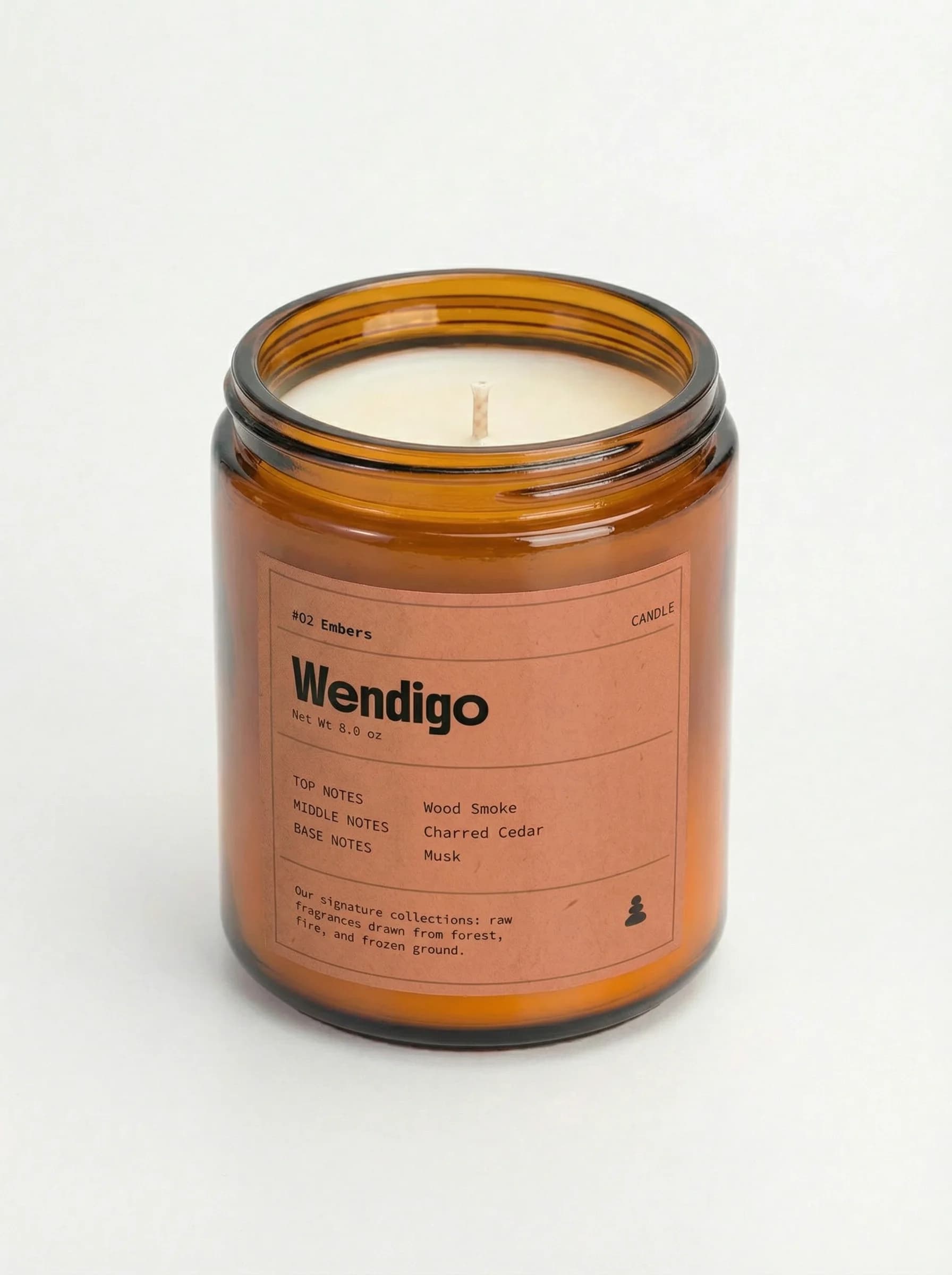
Embers | 4/5 | 4.5/5 | 3.5/5 | mid-heavy
Frozen Earth | 2/5 | 4/5 | 3/5 | base-heavy
Black Pine | 3.5/5 | 4.5/5 | 4/5 | mid-balanced
Birch & Bone | 4/5 | 4.5/5 | 3/5 | mid-heavy
Cabin | 3.5/5 | 4.5/5 | 3.5/5 | base-balanced
Frozen Earth is the clearest example of the divergence: cold throw is 2/5 (you almost cannot smell it in the jar), hot throw is 4/5 (it fills a room). The composition is built on petrichor, vetiver, and wet stone — base notes that need heat to volatilize.
How to read another brand's throw spec
If they publish numbers without conditions, the numbers are not directly comparable to anyone else's. Ask what protocol they use. If they don't have one, the numbers were not produced by measurement.
If they describe throw qualitatively, treat it as marketing language and look for proxy specs: fragrance load percentage and wax type, which together predict throw within a reasonable range.
If they describe throw at all, they are ahead of most of the category.
If they describe throw at all, they are ahead of most of the category.
Wendigo & Co.