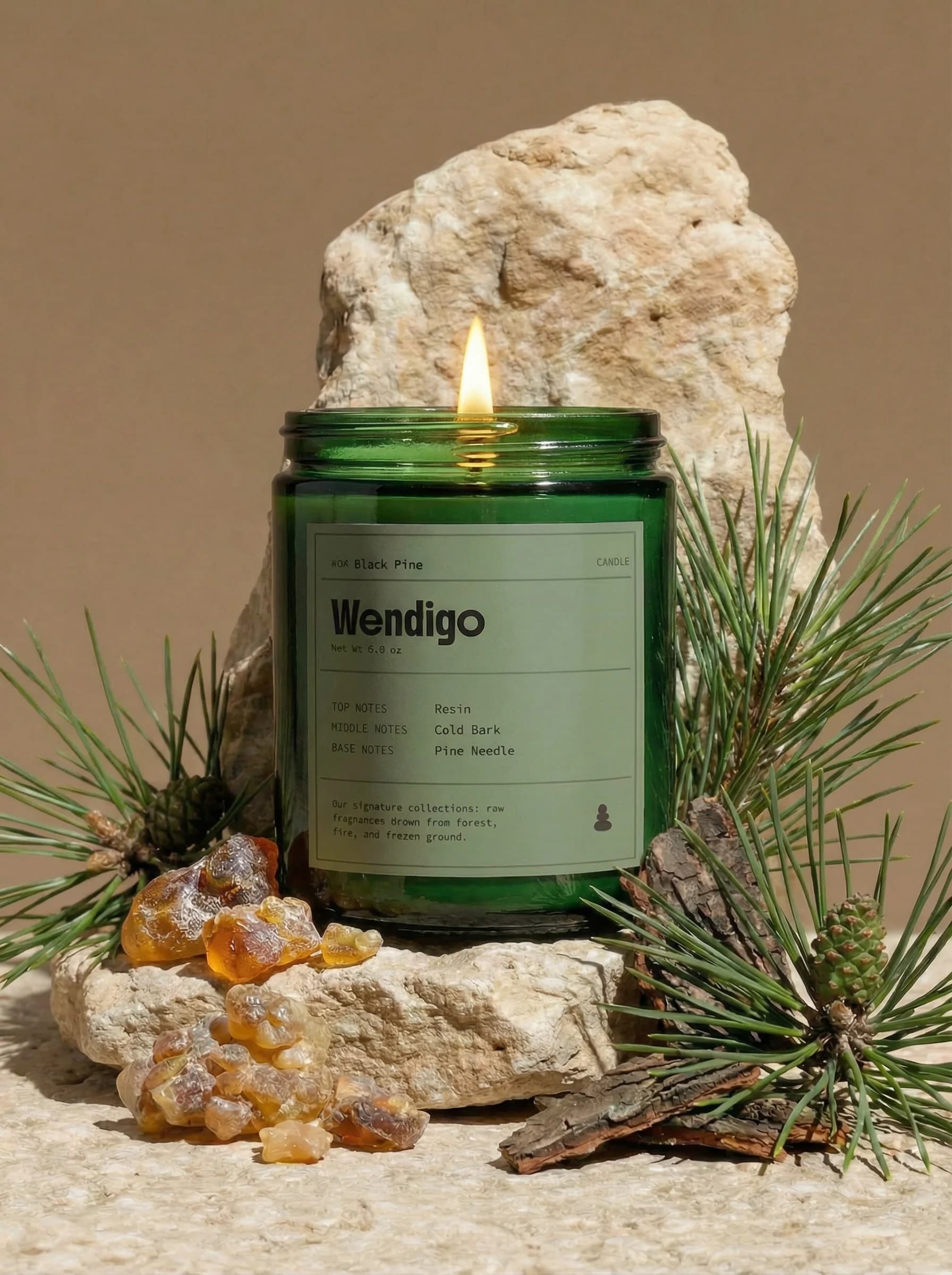
Folk-horror as an aesthetic operates on a small number of recognizable elements: rural settings, ecological dread, the past pressing on the present, isolation, weather. Translating that into a scent profile is not a question of choosing "scary" notes. It's a question of choosing notes that carry the same set of associations and removing the ones that would soften them.
This is how we construct a folk-horror scent, using Cabin as the worked example.
The brief
Cabin should smell like an unheated wooden structure in a temperate forest in late autumn. Wood, cold, residual smoke from a fire put out hours ago, the metallic edge of approaching frost. The cabin has been closed for weeks. Someone is opening it for the first time.
It should not smell warm. It should not smell welcoming.
That second constraint is the harder one. Most candle compositions involving wood and smoke default toward warm cognitive register — fireplace, lodge, holiday. The folk-horror brief required removing the elements that would push the composition there.
Top notes (first 0–20 minutes of burn)
These set the first cognitive register. They have to signal cold quickly.
Cold air accord (4% of fragrance composition). A custom synthetic accord built around aldehydes and a trace of mint isolate. Reads as the smell of outdoor air entering a room when a door opens. Not minty in the obvious sense — the mint isolate is at sub-perceptual concentration and contributes only a faint metallic chill.
Dry pine needle (Pinus sylvestris needle oil), 3%. Dry-distilled, sharper and more brittle than the wet-green of fresh pine. Reads as needles underfoot in late autumn.
Black pepper, 1%. Trace quantity. Adds small cognitive sharpness without reading as a kitchen note.
The total top-note fraction is 8% — relatively small. The composition is deliberately not top-heavy. It identifies itself quickly but does not announce itself.
Heart notes (20–90 minutes of burn)
This is the primary identity of the composition.
Smoked cedar (22%). Cedarwood essential oil with low-concentration guaiacol. The smoke is structural rather than literal — it doesn't read as "fireplace" or "campfire," it reads as wood that has been near fire and held the scent.
Dry hay absolute (14%). Coumarin-forward hay absolute. The smell of barns in autumn, slightly sweet but in a dry register.
Birch bark accord (12%). Distinct from birch tar — lighter, more papery, less smoky. Reads as the outside surface of a tree rather than as the dark interior of pyrolyzed wood.
Iris root, 4%. A trace floral, kept low. Provides depth without warmth or sweetness.
The heart accounts for 52% of the composition. This is unusually heart-heavy for a candle — most compositions distribute more evenly between heart and base — and it's the structural decision that gives Cabin its identity. The buyer experiences the heart for most of the burn duration.
Base notes (90+ minutes, persistent and dominant late in the burn)
These provide the long drydown and the structural shadow under the brighter wood notes.
Vetiver (Vetiveria zizanioides, Haitian), 14%. Earthy, slightly mineral. Vetiver is the spine of many woody-base compositions; it provides depth without sweetness.
Labdanum, 10%. Resinoid, slightly leather-adjacent. Provides body. Often used to read as "warm leather" — used carefully here at lower concentration to avoid warming the composition.
Birch tar, 1%. Very low concentration. Functions as a structural shadow under the brighter wood notes. At higher concentrations it would dominate; at 1%, it adds depth that registers below conscious detection.
Ambrox, 5%. Synthetic amber. Stabilizes the composition and extends the drydown. Most clean-fragrance candles use ambrox; the alternative (natural ambergris) is unavailable for ethical reasons.
The construction logic
Folk-horror as a scent works through absence rather than presence. The notes are familiar — wood, hay, pine, smoke — but the composition removes the elements that would make them comforting:
No vanilla
No sweet spice (cinnamon, clove, nutmeg)
No warm florals (rose, jasmine)
No resinous incense (frankincense, myrrh)
No honey or amber sweetness
What's left is the same set of materials, rendered cold. The pepper and the cold air accord at the top function as a signal that the scent is not in the warm-wood category. Within thirty seconds of lighting, the buyer's nose knows this is not a holiday candle. The hay and birch bark in the heart provide the structural identity. The vetiver and labdanum in the base give the composition the long, slightly oppressive drydown the brief required.
What we did not use
Camphor. Too medicinal. Would push the composition toward "cabin where someone was sick" rather than "cabin in autumn."
Oud. Too oriental in cognitive register. Wrong cultural register for the folk-horror brief — folk-horror is northern hemisphere temperate, not desert or tropical.
Leather notes. Would push the composition into a warmer, more masculine register. The labdanum carries a small leather suggestion which was the most we wanted.
Fresh greens. Would soften the cold. Folk-horror is post-growth, not springtime.
Wet earth. Would push toward Frozen Earth's territory. Cabin needed to feel structural, not geological.
The test
A composition like this is evaluated by whether it produces the right cognitive response. Cabin was tested with a panel of 32 readers who self-identified as folk-horror viewers (consumers of The Wicker Man, Midsommar, The Witch, related literature). 28 of 32 identified the scent as "fitting" the genre without prompting. The remaining four identified it as a cold forest scent without genre association. None identified it as warm or comforting.
This was the result we were testing for. The composition wasn't trying to scare anyone — it was trying to occupy the same cognitive register as the genre. A candle that reads as "cabin in autumn" is doing its job. A candle that reads as "haunted" is overworking the brief.
Where this approach generalizes
The principles are the same for any composition with a specific cognitive register:
Identify the cognitive register the composition needs to occupy
Identify the standard notes for that register
Identify the notes that would push the composition out of register
Build the composition to use the first and exclude the second
This is the same logic perfumers have used for decades. What's specific to a folk-horror brief — or to any brief with a strong negative space — is the discipline of removal. Most compositions get worse when notes are removed. A folk-horror composition gets worse when notes are added.
A folk-horror composition gets worse when notes are added.
Wendigo & Co.