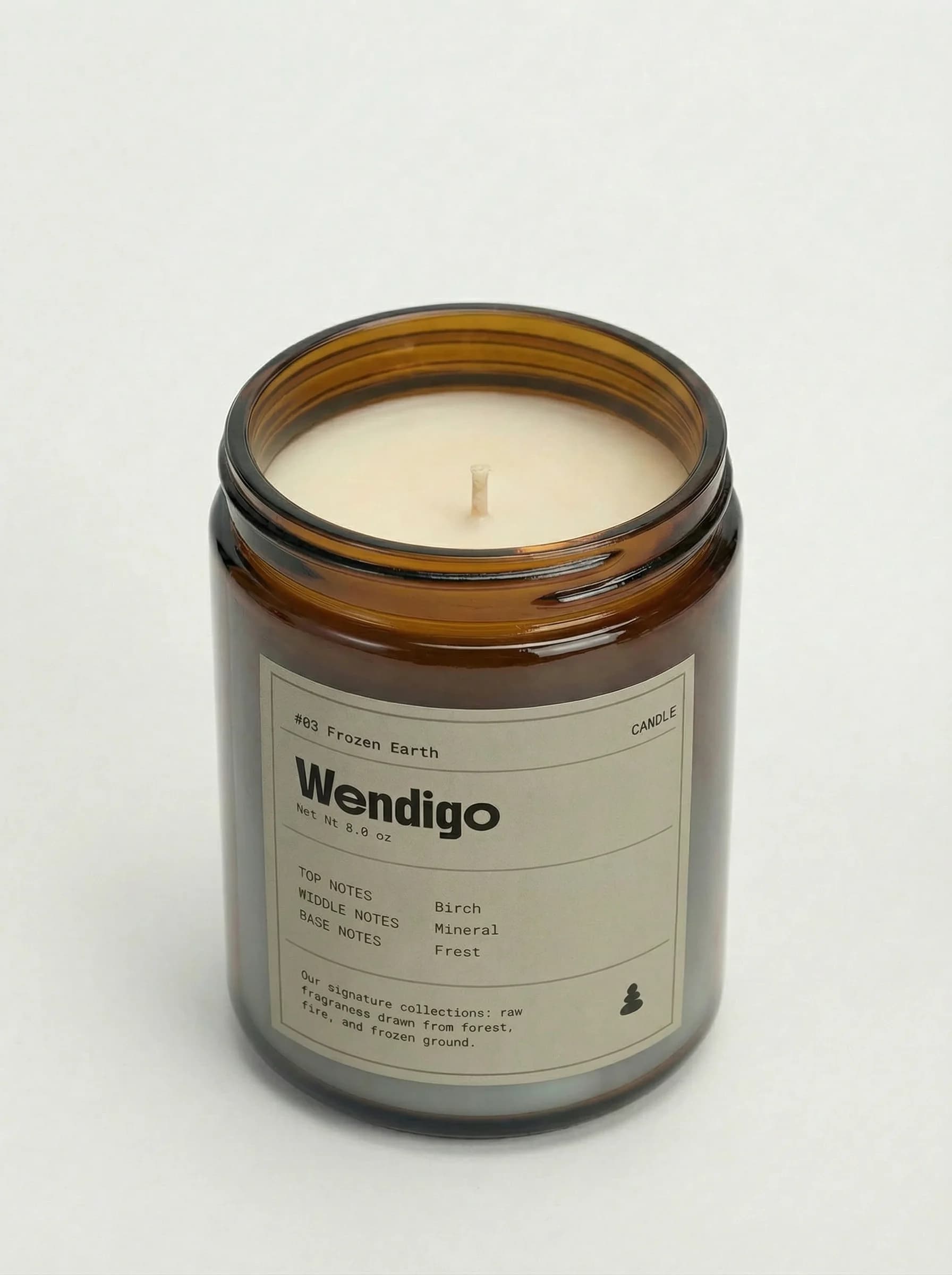
The design-forward independent candle category — brands in the $30–50 range that compete primarily on packaging, scent identity, and collection narrative — has become the most crowded segment of the market. The candles inside the packaging are not equally specified.
This is a comparison of Wendigo against the category's typical formulation profile. We aren't naming specific brands. The category profile is consistent enough that the comparison holds.
Category typical (design-forward independent, $30–50, 8 oz)
Wax: coconut or coconut-soy blend. Ratio usually not disclosed.
Wick: cotton, lead-free. Single brand standard, sometimes premium.
Fragrance: parfum, often phthalate-free per brand statement. Composition listed by note family (top/heart/base) in marketing terms, not by ingredient.
Vessel: designed glass, often opaque or printed, sometimes with a decorative element.
Burn time: published as a single number (often 50–60 hr) without protocol.
Throw: not published.
Per hour: $0.60–0.90.
Wendigo (9 oz, $58)
Wax: 90% coconut, 10% rapeseed. Ratio published.
Wick: FSC-certified cherrywood, single-ply. Source disclosed.
Fragrance: IFRA 51 compliant, phthalate-free declaration on file. Composition disclosed at note-family level with Latin binomials for essential oil components.
Vessel: clear soda-lime glass, undyed, 9 oz capacity.
Burn time: 50–55 hr with three-batch protocol.
Throw: published per scent at 1m and 3m, 70°F.
Per hour: $1.12.
Where the design-forward category is stronger
Object value. The vessel is often genuinely desirable as an object. Many buyers keep the empty vessels as catchalls or planters. This is real value and we don't match it.
Scent variety. The leading brands run 30–50+ SKUs across rotating collections. Wendigo runs 6.
Price tier. A $36 candle is a more accessible category entry point than a $58 one.
Design coherence. The leading brands have visual identities that are immediately recognizable. The category exists because design matters.
Where Wendigo is stronger
Material disclosure. The wax ratio, wick certification, fragrance composition, and burn protocols are all published. In the design-forward category, most of these are not.
Spec depth. Throw, soot index, melt pool diameter, and time-to-steady-state are tested and published per scent.
Fragrance composition transparency. The notes are listed by ingredient and binomial rather than by marketing description.
The honest comparison
These are not directly competing offers. The design-forward category sells you an object that smells nice. Wendigo sells you a documented formulation in a deliberately undecorated vessel. Both can be the right answer.
If the vessel will sit on a shelf you look at every day, the design-forward category may be the better fit even at lower spec disclosure. If the candle will sit on a side table and what matters is what's in it, Wendigo is the better fit.
The two failure modes:
Paying design-tier prices and getting design-tier disclosure when you wanted formulation transparency.
Paying Wendigo-tier prices for the disclosure and finding you actually wanted the vessel.
The spec sheet tells you which one a brand is selling. The product page either has the seven items listed above or it doesn't.
The product page either has the seven items listed above or it doesn't.
Wendigo & Co.