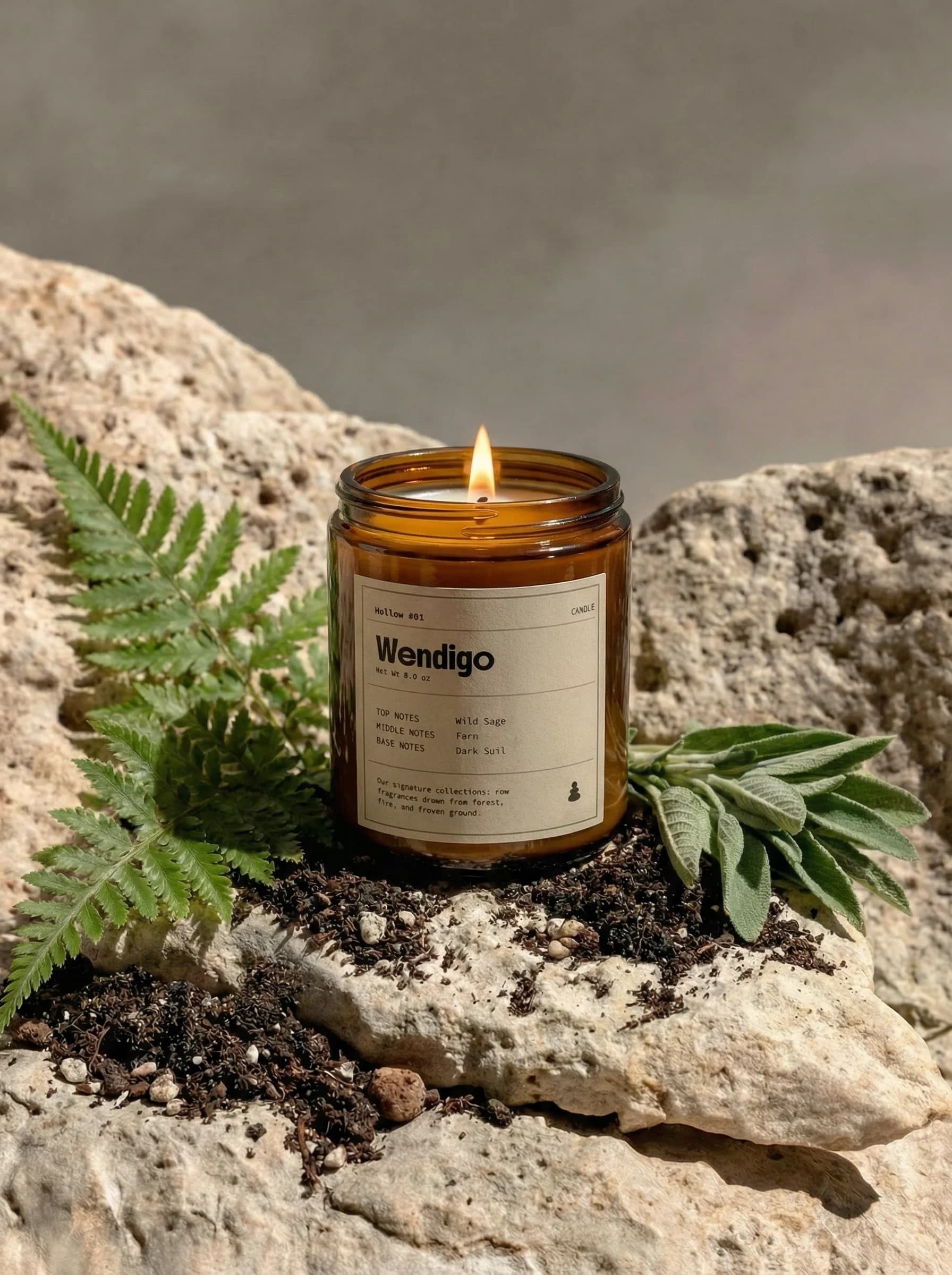
Three wax categories account for nearly all candles sold in the consumer market. The chemistry, sourcing, and burn behaviour of each is measurable. This is the technical comparison.
Paraffin
Origin. Petroleum byproduct. Refined from the heavy distillates of crude oil — specifically the slack wax fraction, further refined and de-oiled.
Chemistry. Saturated hydrocarbons, chain length C20–C40. Crystalline structure varies with refinement grade (fully refined paraffin has tighter crystal packing than scale wax).
Melt point. 46–68°C depending on grade. Container-grade paraffin sits around 52–55°C.
Combustion. Burns hotter than plant waxes. Complete combustion produces CO₂ and water. Incomplete combustion — common with oversized wicks or in drafts — produces particulate matter at higher rates than plant waxes in side-by-side air quality testing.
Fragrance retention. Excellent. Paraffin's nonpolar structure dissolves most fragrance compounds readily. This is the technical reason paraffin throws strongly at lower fragrance loads.
Sourcing concerns. Petroleum supply chain. Upstream carbon footprint significant. Not renewable.
Soy
Origin. Hydrogenated soybean oil. Native soybean oil is liquid at room temperature; hydrogenation saturates the carbon-carbon double bonds and raises the melt point.
Chemistry. Triglycerides of saturated fatty acids, primarily stearic (C18:0) and palmitic (C16:0) after hydrogenation. The triglyceride backbone affects how fragrance binds and releases.
Melt point. 49–82°C depending on hydrogenation degree. Container-grade soy sits around 50–54°C.
Combustion. Burns cleaner than paraffin at typical use rates. Lower combustion temperature.
Fragrance retention. Lower than paraffin. The triglyceride structure binds fragrance compounds less effectively, which is why soy candles often require higher fragrance loads to achieve comparable throw — or are blended with paraffin to compensate.
Sourcing concerns. Predominantly U.S. agricultural. Approximately 94% of U.S. soy is genetically modified. Land use, fertilizer runoff, and monoculture rotation are systemic concerns. Non-GMO certified soy wax exists but represents a small fraction of supply.
The label trap. "Soy wax" can legally describe any blend containing soy. Industry norm for products marketed as soy candles is 60–70% soy with paraffin balance. Without a disclosed ratio, assume the higher paraffin fraction.
Coconut
Origin. Hydrogenated coconut oil. Same hydrogenation principle as soy.
Chemistry. Triglycerides dominated by medium-chain fatty acids — lauric (C12:0) at ~50%, myristic (C14:0) at ~18%, with lower contributions from palmitic and stearic. The shorter chain length produces a lower native melt point and a different crystalline structure than soy.
Melt point. 38–43°C for pure hydrogenated coconut. This is too soft for container candles in warm rooms, which is why coconut is almost always blended with a structural co-wax (rapeseed, apricot, or soy).
Combustion. Clean. Comparable to soy at typical use rates, slightly better in some studies.
Fragrance retention. Strong. Coconut wax holds fragrance well and releases it efficiently at burn temperature. The combination of low melt point and high fragrance retention produces strong throw at relatively short ramp times.
Sourcing concerns. Predominantly Southeast Asian (Philippines, Indonesia). Supply chain has fewer monoculture concerns than soy but raises questions about smallholder labor practices and shipping emissions. Quality varies by supplier.
Rapeseed (Canola)
Origin. Hydrogenated rapeseed oil. European supply chain is more established than North American.
Melt point. 54–60°C. Higher than coconut, lower than fully hydrogenated soy.
Function. Used primarily as a structural co-wax with coconut. Improves hardness, slows the melt pool, stabilizes the burn. Used alone, throw is moderate.
Spec comparison, 9 oz candle, 8% fragrance load
| Paraffin | Soy (typical blend) | Coconut/Rapeseed (90/10)
Burn time, avg | 45 hr | 50 hr | 52 hr
Throw at 1m | 5/5 | 3/5 | 4.5/5
Soot index | 3/5 | 1.5/5 | 1/5
Time to full melt | 1.5 hr | 2.5 hr | 2.0 hr
Raw wax cost, $/lb | $1.20 | $2.40 | $7.50
Renewable | no | yes | yes
Disclosure norm | rare | partial | brand-dependent
Why we use 90/10 coconut/rapeseed
We tested 100% coconut (too soft, wet edges, structural failure at 75°F+), 80/20 coconut/rapeseed (acceptable, slightly reduced throw), and 70/30 (acceptable, throw notably reduced). The 90/10 blend sat at the inflection point where structural integrity was reliable and throw remained strong.
The rapeseed comes from a non-GMO European supplier. The coconut comes from a single Philippine supplier with audit documentation. We do not use soy primarily because we cannot get the same audit depth on soy supply at our volume.
What none of this tells you
Wax type is a necessary spec but not a sufficient one. A 100% coconut wax candle with poor wick matching and overloaded fragrance will burn worse than a well-formulated soy candle. The wax category is the floor of the formulation, not the ceiling.
The wax category is the floor of the formulation, not the ceiling.
Wendigo & Co.