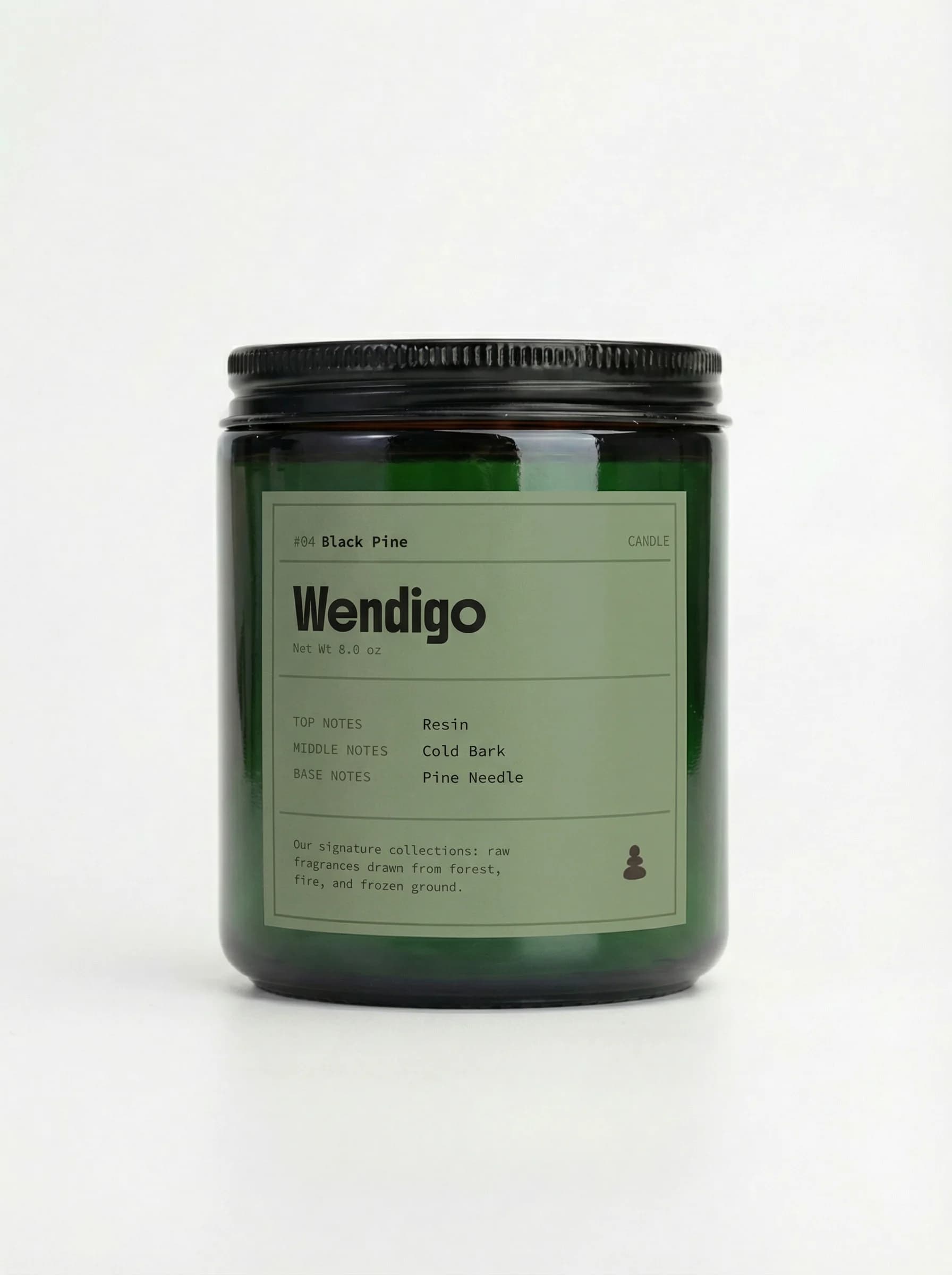
If you have been burning $20 soy candles for years and are wondering whether a $58 candle is genuinely different — not just more expensive — this is the comparison.
We are not naming a specific competitor. The category is consistent enough that a generalized profile is more useful than a single brand callout.
The mass-market soy candle (typical 8oz, $18–24 tier)
Wax: soy or soy blend. Ratio not disclosed. Industry norm is 60–70% soy with paraffin balance.
Wick: cotton, lead-free (required by law since 2003).
Fragrance: undisclosed composition. Load typically 5–7%. Phthalate-free status varies; often unstated.
Vessel: 8 oz glass, often dyed or printed.
Burn time: 35–45 hours, usually published without protocol.
Throw: not published.
Per hour: $0.45–0.65.
Wendigo Birch & Bone (9oz, $58)
Wax: 90% coconut, 10% rapeseed. Ratio published per batch.
Wick: FSC-certified cherrywood, sourced from managed forests.
Fragrance: IFRA-compliant, phthalate-free. 8% load. Composition disclosed by note family with Latin binomials for essential oil components.
Vessel: 9 oz clear glass, undyed.
Burn time: 52 hours average, three-batch protocol published.
Throw: 4.5/5 at 1m, 3/5 at 3m, measured at 70°F still air.
Per hour: $1.12.
Where the price difference actually goes
Wax cost: coconut wax runs roughly 3x soy wax by weight.
Wick cost: FSC cherrywood runs roughly 4x cotton.
Fragrance cost: premium custom composition runs roughly 2x mass-market fragrance oil.
Disclosure infrastructure: burn testing protocol, per-scent composition publishing, sourcing audits. Ongoing operational cost.
The $40 retail delta is approximately $7 in materials. The rest funds formulation work, QC, and the disclosure layer.
Is the premium real
It depends on what you are buying for.
If you are buying scent, the difference is real but not dramatic. A well-formulated soy candle at $20 can throw competently in a 200 sq ft room. Birch & Bone throws further (300+ sq ft) with a more complex composition, but the marginal scent-per-dollar favors the mass-market option.
If you are buying disclosure, the difference is significant. You will not get a published wax ratio, fragrance composition, or burn protocol at the $20 tier. If those things matter to you, the premium is the disclosure.
If you are buying burn quality, the difference is moderate. Coconut wax with a wood wick produces a wider melt pool, less tunneling, and lower soot than typical soy-paraffin blends with cotton wicks. Measurable, but not life-changing.
Which to choose
If you burn candles frequently and want maximum scent-per-dollar, the mass-market tier is rational.
If you want to know what is in the candle and how it performs — and you are willing to pay for that knowledge — the premium tier is rational.
Both can be the right answer. The wrong answer is paying premium-tier prices for mass-market-tier disclosure.
The wrong answer is paying premium-tier prices for mass-market-tier disclosure.
Wendigo & Co.