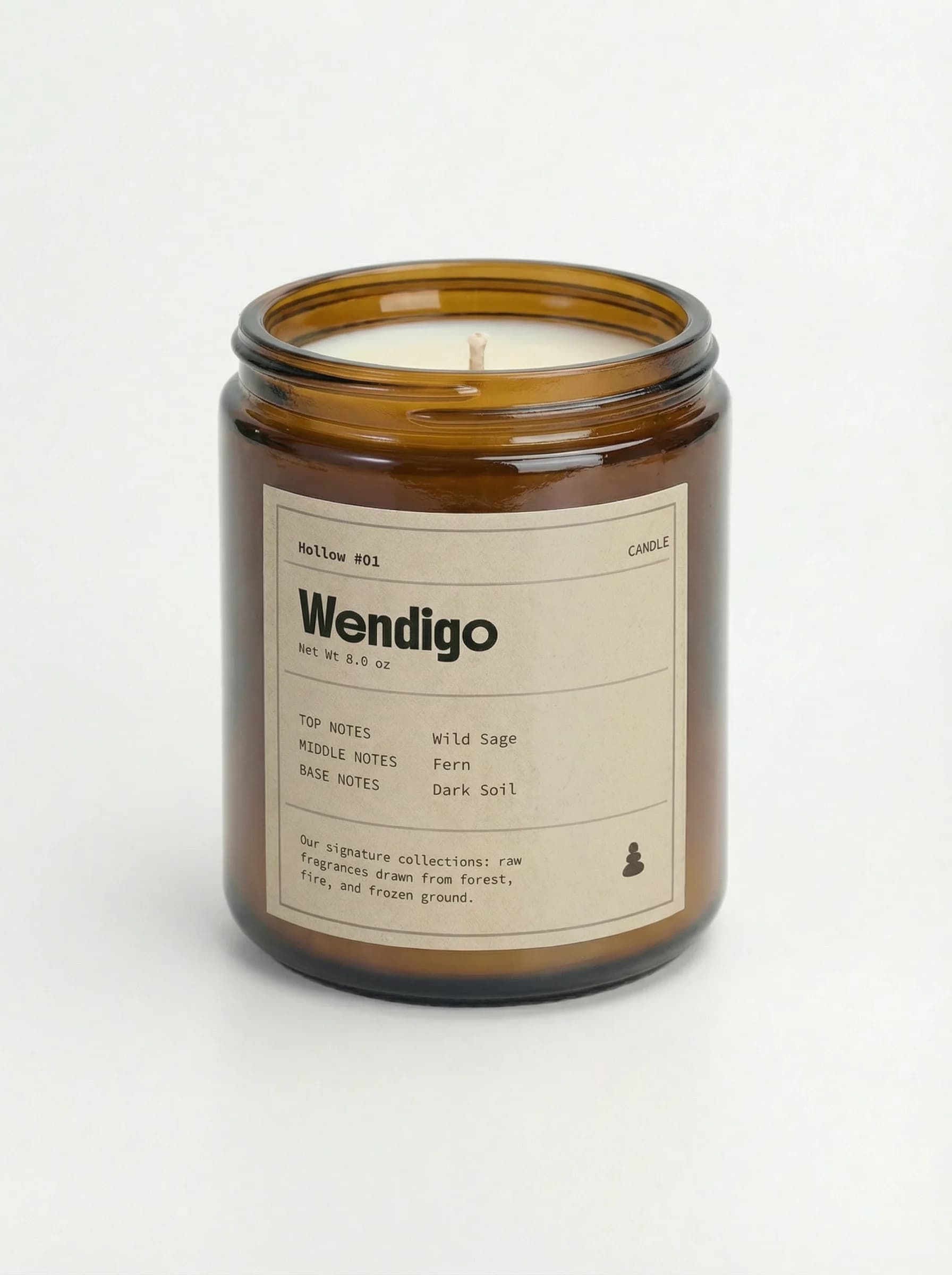
Fragrance notes are described in language that often communicates very little. "Smoky," "woody," "earthy" — these are categories large enough to cover materials that smell almost nothing alike.
This is a literal account of three of the most-used notes in the Wendigo line: what they are, where they come from, and what they actually do in a composition.
Birch tar
Distilled from the bark of Betula pendula (silver birch) or Betula lenta (sweet birch). The bark is heated in the absence of oxygen — a process called dry distillation, or pyrolysis — and the resulting black, viscous tar is collected.
The note is smoky, leathery, and faintly medicinal. Closer to the smell of old leather, wet asphalt after rain, or a creosote-treated bandage than to wood smoke. Birch tar is one of the few perfumery materials that genuinely smells like a place rather than an object. It carries the specific cognitive register of "outdoors, old, exposed to weather."
In Wendigo Birch & Bone, it's the dominant base note at 14% of the fragrance composition. At that concentration it doesn't read as a single identifiable smell — it reads as the dark, slightly oppressive quality that holds everything else in place. Used at 1–2% (as it is in Cabin), it disappears into the background as a structural shadow.
Birch tar was historically used in leather tanning (Russian leather, the original perfumery reference) and in folk medicine. The note carries some of those associations even now.
Petrichor
Not a single compound. Petrichor is the layered scent of rain falling on dry earth, named in a 1964 paper by two Australian scientists, Bear and Thomas. The smell is produced by:
Geosmin, a bicyclic alcohol produced by soil-dwelling Streptomyces bacteria. Geosmin is one of the most powerful odorants known — the human nose can detect it at concentrations as low as 5 parts per trillion. It's why beets taste earthy and why a freshly turned garden smells the way it does.
2-methylisoborneol, another microbial metabolite, similar cognitive register to geosmin but slightly more mineral.
Plant oils that have absorbed into clay surfaces during dry periods and are released when rain hits them.
A "petrichor accord" in perfumery is a reconstruction. Usually built around geosmin (which is commercially available as a synthetic isolate), a mineral note (often a custom stone accord), and a trace of green vegetation (vetiver root, sometimes oakmoss).
In Wendigo Frozen Earth, the petrichor accord is the heart note. It bridges a cold mineral top to a heavier vetiver-and-stone base. The note reads as cold, slightly bitter, slightly sweet, and unmistakably wet. People who don't know what petrichor is often describe Frozen Earth as "smelling like outside after rain" without knowing they're identifying the accord by name.
Smoked cedar
Cedar essential oil paired with a smoke distillate or with a smoky compound at low concentration. The cedar is usually Cedrus atlantica (Atlas cedar, from Morocco) or Juniperus virginiana (Virginia cedar, technically a juniper). The smoke component is typically guaiacol — a naturally occurring compound found in wood smoke, beech tar, and roasted coffee — used at trace concentrations.
The result is a dry, woody note with a charred edge. Closer to the smell of a recently extinguished campfire than to a burning one. It is not sweet. It does not read as "fireplace." It reads as the wall of a structure that has been near fire.
In Wendigo Embers and Black Pine, smoked cedar functions as a bridge note — connecting the resinous evergreen top notes to the smokier bases without forcing the composition into either an outdoor fire register or an indoor incense register.
The distinction matters because "smoky woods" as a category covers an enormous range. Mass-market candles labeled "smoked cedar" or "campfire" often use synthetic smoke fragrance oils that read as artificial — too sweet, too uniform. The combination of real cedar essential oil with low-level guaiacol is structurally different. It reads as smoke that has cooled.
Why this matters
Buying fragrance based on note names is like buying coffee based on the word "earthy." The category covers materials that don't smell alike, don't behave alike in a composition, and don't perform alike when heated.
The materials behind the words have specific molecular identities and specific costs. A composition that lists "birch" might contain Betula leaf oil (light, green, papery), birch bark accord (drier, more architectural), or birch tar (smoky, leathery, dense). They are not interchangeable. They will not produce similar candles.
Every Wendigo scent's product page lists the dominant materials by name, with the Latin binomial where applicable, and the approximate percentage of the fragrance composition. The synthetic aroma molecules beyond the named accords are listed by IFRA category. The brand position is that fragrance is not too complicated to discuss specifically. It is just rarely discussed that way.
It is just rarely discussed that way.
Wendigo & Co.