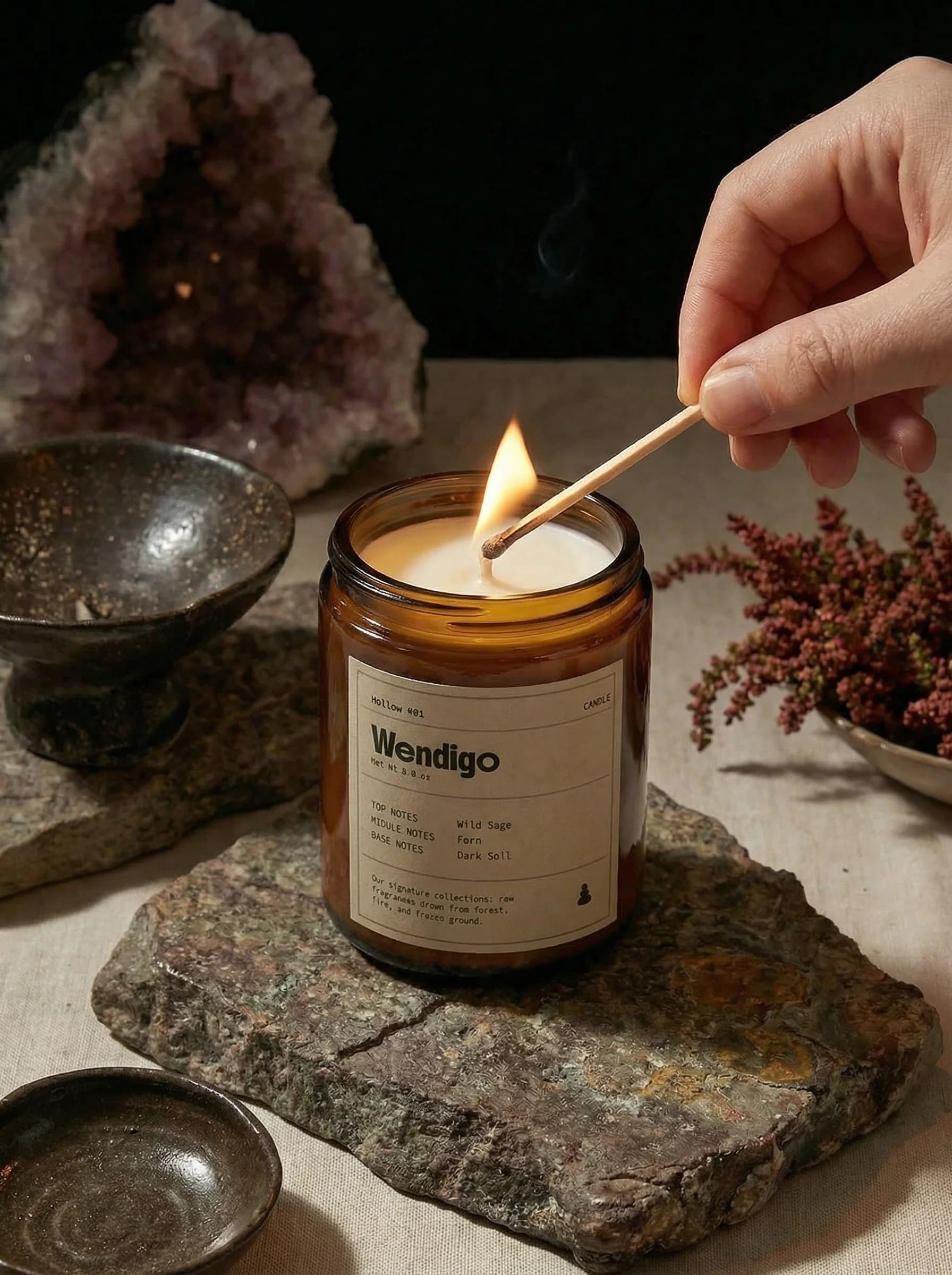
Candles span roughly $5 to $200 at retail. Most of the difference isn't packaging. This is what changes as the price climbs, what doesn't, and how to tell whether a premium price is buying you something or just costing you something.
$5–15 (mass market)
What you're buying:
Paraffin or paraffin-soy blend wax (60/40 typical)
Cotton wick, lead-free
Undisclosed fragrance oil at 4–6% load
Thin glass or plastic vessel, often dyed
Burn time of 25–35 hours
Strong, often synthetic-reading fragrance
Per hour: $0.15–0.50
This tier is rational if you burn candles casually and want scent in a room without thinking about it. The formulation is engineered for throw at low cost; combustion isn't optimized.
$15–35 (entry premium)
What changes:
Wax shifts to soy or soy blend (still often with paraffin component)
Wick is cotton, sometimes premium cotton
Fragrance load rises to 6–8%; phthalate-free claims become common
Vessel is heavier, often branded glass
Burn time extends to 35–50 hours
Scent quality improves materially — less synthetic, more layered
Per hour: $0.40–0.80
This is where the candle starts feeling like a considered object rather than a household supply. The biggest jump in per-hour value happens here.
$35–60 (mid premium / independent)
What changes:
Wax shifts toward coconut-based blends
Wick may shift to wood or premium cotton
Fragrance load typically 7–9%, often IFRA-compliant and phthalate-free
Vessel is heavy glass or ceramic, often designed as an object
Burn time 45–60 hours
Scent compositions become more distinctive, sometimes with disclosed notes
Per hour: $0.65–1.30
The value-per-dollar improvement narrows here. You're paying for design coherence, scent identity, and brand position as much as for formulation.
$60–100 (premium independent / niche) — where Wendigo sits
What changes:
Wax is 100% coconut or coconut-rapeseed blend with disclosed ratios
Wick is FSC-certified wood or premium cotton with traceable source
Fragrance load 8–10%, IFRA-compliant, phthalate-free, often with composition disclosed
Burn time 50–60 hours, sometimes published with protocol
Throw measured and published with conditions
Per hour: $1.00–1.80
Wendigo's 9 oz at $58 is $1.16 per hour. The price reflects:
~$14 in materials
Burn testing protocol per batch
Per-scent fragrance composition publishing
FSC sourcing premium on wick
Custom fragrance composition (not a stock fragrance oil)
You're paying for disclosure infrastructure as well as for materials. That's a real cost; whether it's worth it depends on whether you want the information.
$100+ (luxury / artisanal)
What changes:
Wax may include rare bases (beeswax, bayberry, etc.)
Wick is wood or premium cotton
Fragrance load 8–10% with rare materials (oud, ambergris substitutes, specific botanical isolates)
Vessel is often an art object — hand-thrown ceramic, hand-blown glass, sometimes limited edition
Burn time 60–80 hours
Scent compositions are sometimes intentionally subtle or experimental
Per hour: $1.25–3.00+
Above $100, the marginal spec improvement per dollar drops sharply. A $200 candle is rarely 4x the candle of a $50 one. It's sometimes 4x the object — the vessel, the brand story, the limited availability. Those are real values for some buyers and irrelevant for others.
If you've been burning $15–25 candles and are considering $65–90
The honest framing:
Where the upgrade is real:
Burn quality. The wax-wick match in well-formulated premium candles produces wider melt pools, less tunneling, lower soot. You'll see the difference in the vessel.
Scent complexity. Premium fragrance compositions have more dimensional development. The scent at hour 1 differs from the scent at hour 3 in a way mass-market candles don't usually achieve.
Burn duration. You'll get 50+ hours instead of 30. The per-hour math closes the gap somewhat.
Disclosure. You'll know what's in the candle. Whether that matters to you is the central question.
Where the upgrade is smaller than you might hope:
Throw. A well-made $30 candle and a well-made $80 candle throw within the same general range. Premium throw is more refined, not categorically stronger.
"Feeling good about it." The first premium candle feels meaningful. By the third, the upgrade feels like the new normal.
The honest recommendation
If you've been disappointed by $15–25 candles consistently, the upgrade is worth it. The category really does perform differently at the premium tier.
If you've been satisfied by $15–25 candles and are wondering whether you're missing something — you might be missing some refinement, but the cost-benefit gets thinner the higher you go.
The wrong reason to upgrade is because you feel like you should be buying nicer things. The right reason is because there's something specific the lower tier isn't giving you. If you can name what that thing is, the premium price is buying something real. If you can't, it might not be.
If you can't, it might not be.
Wendigo & Co.