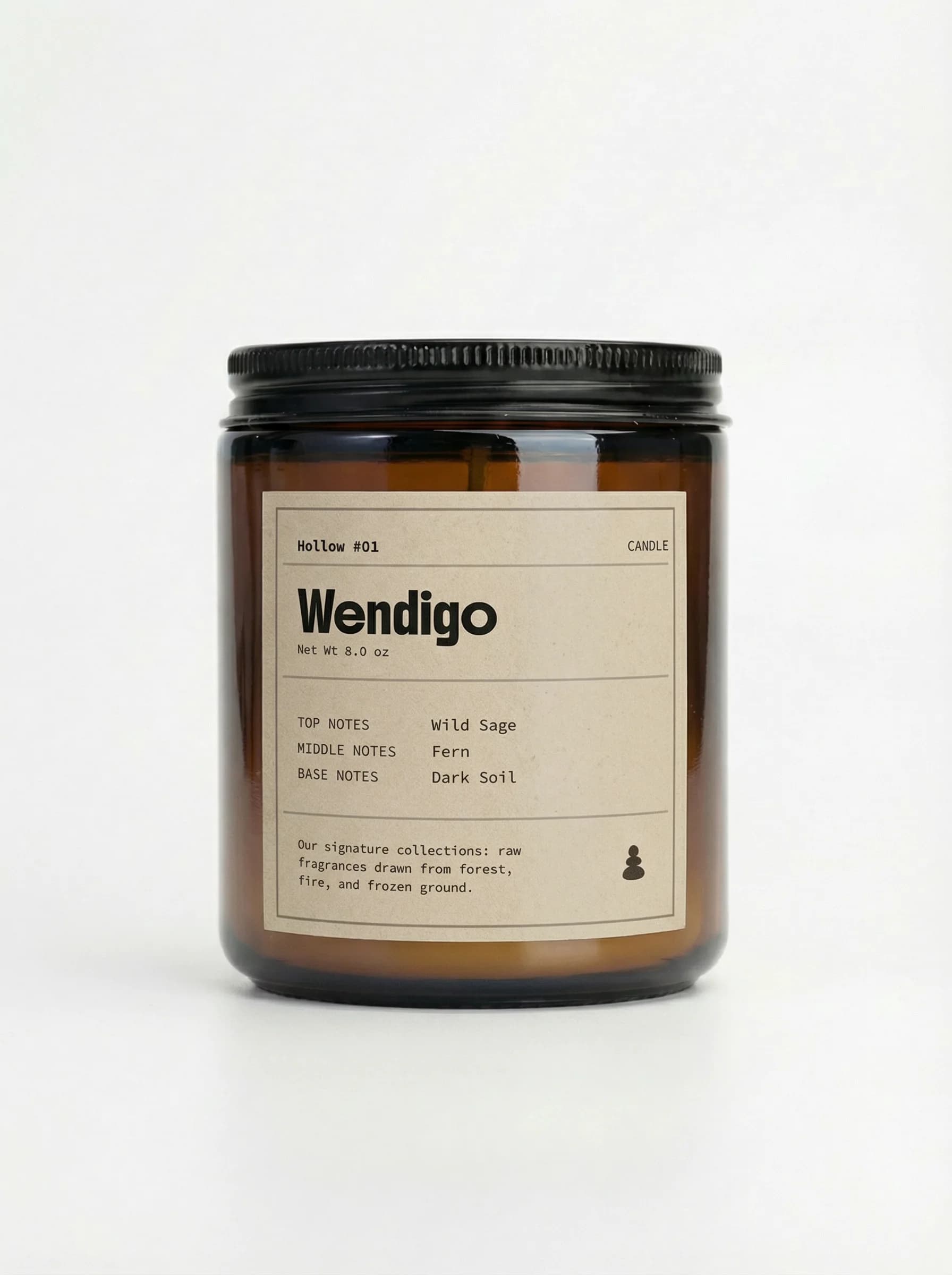
A candle looks simple from the outside: a wick, some wax, a glass jar. The way those three components are matched to each other is what determines whether the candle burns well, throws fragrance, lasts, and ends safely.
This is a walkthrough of how a Wendigo candle is built, starting at the vessel and working in.
The vessel (the glass jar)
Soda-lime glass — the standard glass used for food jars and most candle vessels. Not crystal, not borosilicate. 2.75 inches across at the inside, 3.5 inches tall, holds 9 ounces of wax by weight.
The diameter matters more than it looks. A vessel one size larger would need a bigger wick to melt the wax all the way to the edges. A bigger wick burns hotter, finishes the candle faster, and produces more soot. A vessel one size smaller would tunnel — the flame would melt only a narrow column down the middle and leave a ring of unmelted wax along the wall.
The vessel was chosen first. Everything else was matched to it.
The wax (92% of the weight)
90% coconut wax, 10% rapeseed wax. Both hydrogenated (treated with hydrogen to make them solid at room temperature) and food-grade.
Why coconut: it burns clean, throws fragrance well, and is renewable. The wax cost is higher than soy or paraffin, but the burn quality justifies it.
Why rapeseed at 10%: pure coconut wax is too soft for a container candle in a warm room — it stays slightly liquid at the edges and looks unfinished. Adding 10% rapeseed firms up the structure without changing the burn behaviour.
The two waxes are blended at 71°C, the fragrance is added, and the candle is poured in two stages. The two-stage pour prevents the small sinkholes that form around the wick when the wax cools.
The fragrance (8% of the weight)
8% might not sound like much. In candle terms, it's on the high end of standard — most premium candles run 6–8%. Above 10%, the fragrance oil starts to interfere with combustion and the candle smokes.
The fragrance composition is custom-blended in Grasse, France, the historical center of perfumery. It's IFRA-compliant (meets international fragrance industry safety standards) and phthalate-free (no fragrance solvents from the phthalate chemical family).
Every Wendigo scent has its full composition published on its product page, broken down by note family with the Latin names of the essential oil components.
The wick (small but consequential)
A single piece of cherrywood, FSC-certified (sourced from managed forests under an agency audit). 4mm wide, 0.5mm thick. Anchored to the bottom of the vessel by a small zinc clip.
Why wood and not cotton: cotton wicks are the category default. They burn hotter and ramp up faster. We use wood because coconut wax has a low melt point and low viscosity — a cotton wick burns through it too aggressively, producing a deep narrow melt pool that wastes wax around the edges. The lower-temperature wood wick produces a wider, shallower pool that consumes wax more evenly.
The wood wick also crackles as it burns. That sound is water vapor and resin escaping from the wood. It's a side effect, not the point, but most people prefer it.
The burn curve
Lit on first burn, ambient 70°F:
0:00 — Light. Flame establishes in about 30 seconds. Wood wicks take a slightly longer initial flame from the lighter than cotton — 5–8 seconds is normal.
0:15 — Wax pool is 1.5" across.
0:45 — Wax pool is 2.25" across.
2:10 — Wax pool reaches the vessel wall (2.75"). This is when fragrance throw hits steady state.
4:00 — Wax depth of about 0.4" consumed. Recommended endpoint for the first burn.
After the first burn, every subsequent burn reaches full melt pool faster — usually 70–80 minutes — because the wax "remembers" the pool from before.
End of life
The candle is designed to burn down to about ¼ inch of remaining wax. Below that, the flame can overheat the glass. The wick is anchored at a height that extinguishes the candle before the wax runs out completely.
This is intentional. A candle that burns the last drop of wax is also a candle that can crack its vessel.
What this adds up to
A 9 oz candle that burns 50–55 hours, costs us approximately $14 in materials, and retails at $58. The price funds the formulation work, the burn testing, the FSC sourcing premium, and the disclosure infrastructure that makes posts like this one possible.
If you're choosing your first proper candle, the spec to focus on isn't the price. It's whether the brand can explain what's in it. If they can, the candle was made deliberately. If they can't, it wasn't.
If they can't, it wasn't.
Wendigo & Co.