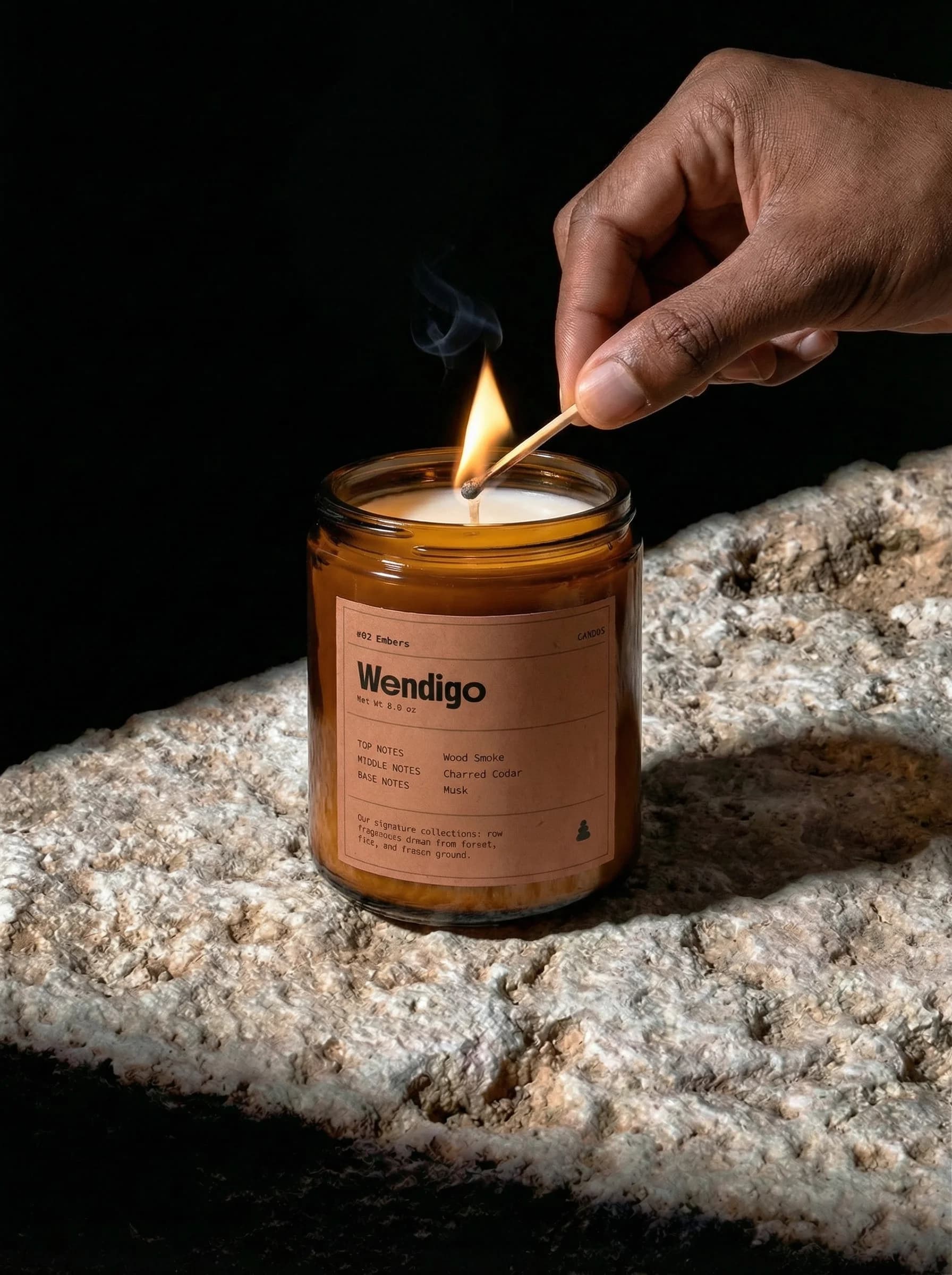
Some fragrance compositions are built for skin. Others are built for air. The materials are similar; the physics are different. A composition that works as a perfume often does not work as a candle, and vice versa.
This is a piece about format choice, using Wendigo Birch & Bone as the worked example.
What a perfume has to do
A perfume sits on skin at body temperature (about 32°C at the surface) and interacts with the wearer's chemistry. The composition is designed to:
Open with volatile top notes that present immediately and burn off quickly
Develop through mid notes that emerge over 20–60 minutes
Settle into a drydown of base notes that persist 4–8 hours
Project outward in a "sillage" — the trail the wearer leaves behind
The wearer experiences the perfume continuously and at intimate range. Other people experience it from a meter or two away, intermittently.
The materials that excel in this format: bright top notes that announce themselves (aldehydes, citrus, light florals), warm mids that bloom on skin (rose, jasmine, spices), and base notes with skin affinity (musks, ambers, sandalwood, light leathers).
What a candle has to do
A candle vaporizes fragrance from a heated wax pool at 70–90°C surface temperature and disperses it into the air of a room. The composition has to:
Build steady ambient presence over 1–3 hours
Project through the volume of a room rather than along a body
Remain coherent at distance (3 meters from the candle, the composition should still read as itself)
Tolerate sustained heat without breaking down
The room experiences the candle continuously. The person in the room moves in and out of proximity.
The materials that excel in this format: base notes that volatilize cleanly at burn temperature (vetiver, cedar, labdanum, ambrox), woods that hold structure at distance (sandalwood, smoked cedar), and resins that fill volume (frankincense, birch tar at controlled load).
The Birch & Bone case
Birch & Bone was developed as a candle. Its composition reads:
Top: cold air accord, black pepper, cypress needle
Heart: smoked cedar, iris root, birch bark accord
Base: birch tar (14%), labdanum, vetiver, dry hay, ambrox
The 14% birch tar in the base is the defining structural choice. Birch tar at that concentration in a perfume would be overwhelming — smoky, leathery, dominant — and it would dominate the wearer for the full 6+ hour persistence of the fragrance. In a candle, it diffuses into the room as a background note. The buyer experiences smoke and leather as part of the atmosphere, not as something on their skin.
This is why Birch & Bone is a candle. Translated directly into a perfume, it would be unwearable for most people. Diffused into room air, it works.
When a composition could be either
Some compositions cross formats well. Sandalwood-amber-musk compositions, for example, work as perfumes and as candles with relatively small adjustments. The materials are stable across temperature ranges and the cognitive register is similar in both formats.
Wendigo doesn't currently make perfumes. The body oil is the closest format we offer to a wearable fragrance, and it's deliberately formulated for close-range only — 4-6 hour skin presence, low projection, no sillage. It carries the same composition as the candle but in a carrier that doesn't try to project outward.
For Birch & Bone specifically, the body oil reduces the birch tar to 4% of the fragrance fraction (versus 14% in the candle), and the carrier oil holds the composition flat against the skin rather than projecting it outward. This is the format adjustment that makes the same composition skin-suitable. A direct translation — same percentages, same intensity, applied to skin — would not work.
When a composition shouldn't cross formats
Compositions built on top notes (citrus, light greens, ozonic notes) usually don't work as candles. The volatile top notes flash off the wax pool too quickly and don't accumulate in the air. A "fresh citrus" candle is almost always either weakly fragranced or compensating with synthetic fixatives that compromise the composition.
Compositions built on smoke, tar, oud, or heavy resins usually don't work as perfumes for most wearers. The materials are too dominant at skin proximity and too persistent across the day. Candles handle these materials better because the room dilutes the composition naturally.
A brand that makes both perfumes and candles in the same scent is making a choice about how to handle this asymmetry. Some brands resolve it by reformulating — the "candle version" of a perfume is often genuinely a different composition. Others ship the same blend in both formats and the candle version underperforms.
What to look for
If a brand makes a candle in a fragrance you also wear, ask whether the composition is the same. If they say yes, the candle is likely either compromised or the perfume is unusually candle-suitable. If they say no, ask what's different. The answer tells you whether they understand the format problem.
If you're choosing between a perfume and a candle of the same notes, the choice is really about where you want the scent to live: on you or around you. They are not substitutes. They occupy adjacent territory with different physics.
They occupy adjacent territory with different physics.
Wendigo & Co.