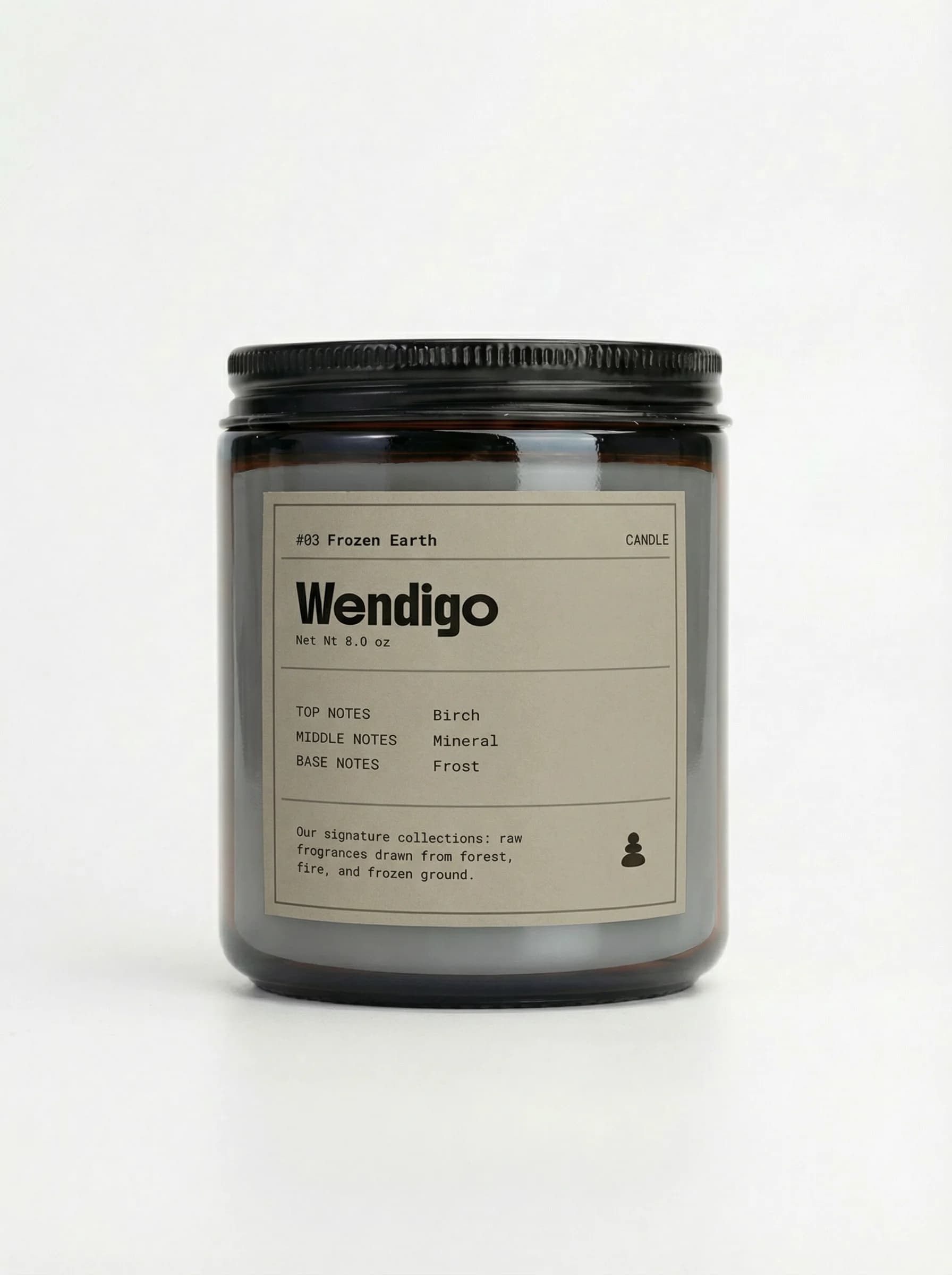
Burn time is the most useful single spec for a candle buyer. It tells you, with reasonable accuracy, what you are paying per hour of use. It is also one of the most commonly omitted or fudged specs in the category.
This is what we publish, how we test it, and why most brands don't.
What we publish, per scent
Three numbers per scent, plus the protocol:
Continuous 4-hour burns: the most demanding protocol. Highest melt rate. Produces the shortest total burn time of the three. For Birch & Bone: 48 hours.
Continuous 8-hour burns: the protocol most consumers approximate when burning candles for long evenings. For Birch & Bone: 50 hours.
2-hour intervals over multiple days: the protocol that most accurately models occasional use. Slowest melt rate, longest total burn. For Birch & Bone: 55 hours.
The published number — 52 hours — is the average. All three are listed on the product page so a buyer who burns differently can choose the most relevant.
Ambient conditions: 70°F, still air, no draft. Wick trimmed to ¼ inch between burns. Three batches tested per scent.
Why most brands don't publish this
Three reasons, in order of how often they apply:
1. Burn time is variable, and variability creates support tickets.
A single number is easy to misinterpret. A candle marketed as "burns 60 hours" that delivers 45 hours under continuous burn is going to generate complaints, even if both numbers are technically correct. The conservative move is to publish a wide range ("30–60 hours") or no number at all.
2. Publishing the number creates accountability.
A brand that publishes 52 hours has committed to a number that buyers can verify. A brand that publishes "long-lasting burn" has committed to nothing. The latter is structurally safer.
3. The number, if published honestly, is often unimpressive.
Mass-market candles burn fast — wax-to-burn-time ratios are unflattering at the bottom of the market. Some premium candles also burn fast (high fragrance loads accelerate melt rates; thin wicks do too). A brand whose burn time is shorter than expected for the price has little incentive to publish.
Why we publish anyway
The buyer is going to measure the burn time of the candle they bought. They will know what they got. The question is whether they get the number from us, before purchase, or from their own experience, after purchase.
We would rather they get it from us.
What burn time does not tell you
It is a necessary spec, not a sufficient one. A long burn time on a poorly formulated candle is not a virtue — it can indicate a wick too small for the wax, which produces tunneling and wastes wax around the vessel walls.
To evaluate a candle's total quality, burn time should be read alongside:
Melt pool diameter and depth (does the wick match the wax)
Soot index (is combustion complete)
Throw at distance (does the fragrance actually project)
Vessel temperature at end of life (is the candle safe to burn down)
A candle with strong numbers across all five is well-formulated. A candle with only burn time published is partially specified.
Per-scent burn time data, current line
Scent | 4hr continuous | 8hr continuous | 2hr intervals | Published average
Hollow | 47 hr | 49 hr | 53 hr | 50 hr
Embers | 46 hr | 48 hr | 52 hr | 49 hr
Frozen Earth | 49 hr | 51 hr | 56 hr | 52 hr
Black Pine | 48 hr | 50 hr | 54 hr | 51 hr
Birch & Bone | 48 hr | 50 hr | 55 hr | 52 hr
Cabin | 49 hr | 51 hr | 55 hr | 52 hr
Updated quarterly. Last revision: Q3.
Updated quarterly. Last revision: Q3.
Wendigo & Co.