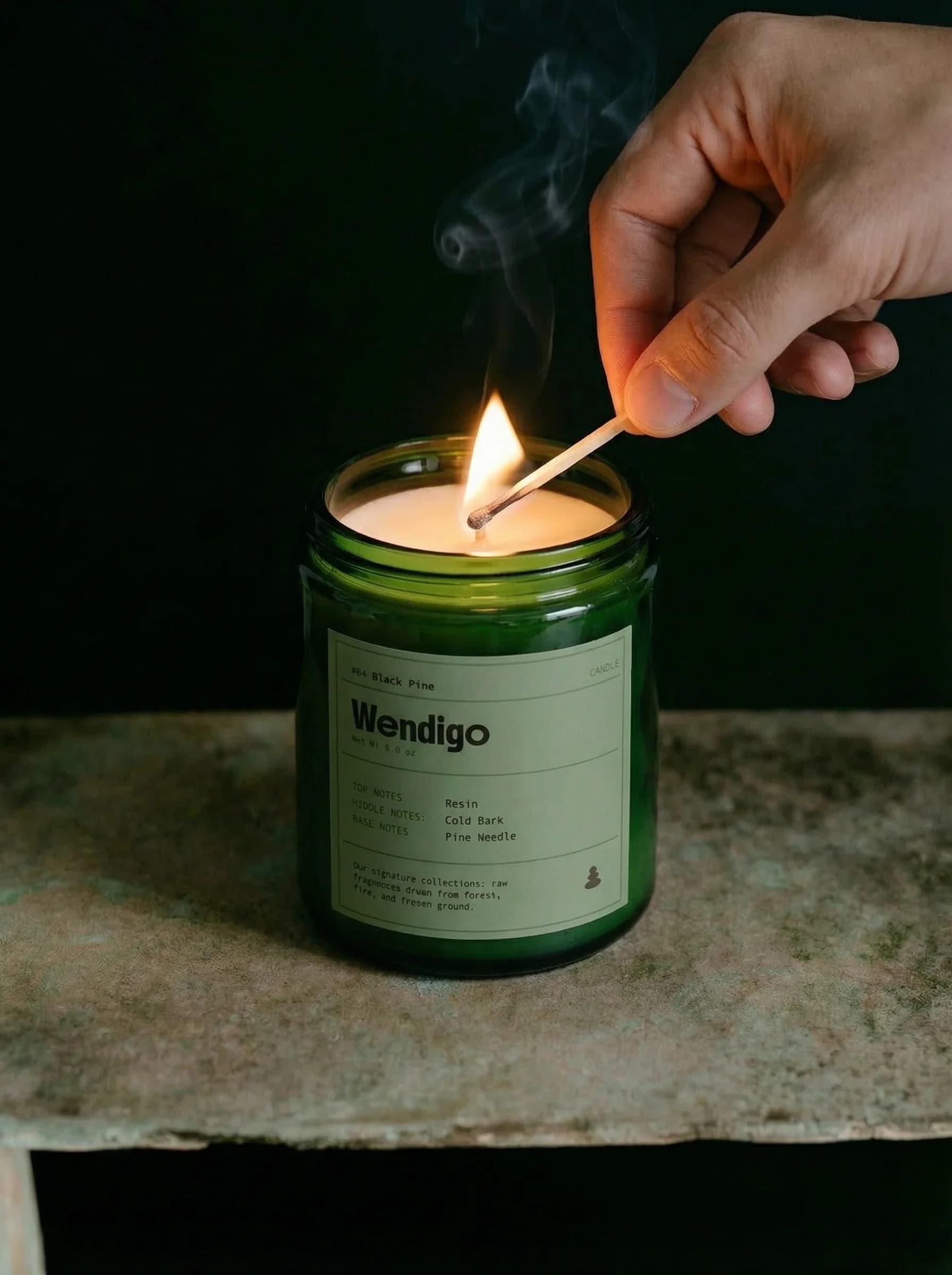
A wick is not a neutral component. It determines burn rate, flame height, melt pool geometry, throw curve, and how the candle ends its life. The choice between cotton, wood, and paper wicks is a real engineering decision with measurable consequences.
This is the technical case for the choice we made.
The three wick categories
Cotton. The category default. Braided cotton fibers, sometimes with a paper or zinc core for rigidity. Burns at flame temperatures around 1000°C at the tip. Ramps to full melt pool in 60–90 minutes in most container candles. Cheap, well-understood, and easy to source. The primary failure mode is mushrooming — carbon buildup at the wick tip that produces uneven burn and soot.
Wood. Single-ply or multi-ply hardwood. Cherry, birch, and maple are most common. Burns at lower flame temperatures than cotton — around 800–900°C at the tip. Ramps slower to full melt pool (90–150 minutes). Holds the flame in a horizontal orientation, which produces a wider and shallower melt pool than cotton's more vertical flame. Roughly 4x the per-unit cost of cotton. Produces an audible crackle.
Paper. Used primarily in very small votives. Burns hot and fast. Not appropriate for vessels over 6 oz.
Why cotton fails with coconut wax
Coconut wax has a low melt point (38–43°C for pure hydrogenated coconut) and low viscosity at burn temperature. A cotton wick burns through low-viscosity wax aggressively — the wax flows up the wick faster than the flame can consume it, the flame grows taller, and the melt pool deepens vertically rather than spreading horizontally.
The result is a candle that:
Burns through wax faster than the published spec
Tunnels around the wick if not given long burns
Produces a narrow, deep melt pool that wastes wax against the vessel wall
Heats the vessel higher than intended
You can solve this with a smaller cotton wick, but a smaller wick produces weaker throw and a higher tunneling risk. The cotton-coconut combination has no good operating point.
Why wood works with coconut wax
The lower flame temperature of a wood wick matches the lower viscosity of coconut wax. The flame consumes wax at a rate the candle can sustain. The horizontal flame orientation produces a wider melt pool that consumes wax evenly across the vessel diameter.
Specifically, in our 9 oz candle with the 90/10 coconut/rapeseed blend:
Time to full melt pool: 2:10 (first burn), 70–80 min (subsequent)
Max melt pool depth at 4hr: 0.35"
Vessel wall temperature at 2hr: 48°C (well within safe range for soda-lime glass)
Soot index: 1/5
The same wax with a comparable cotton wick produced, in our testing:
Time to full melt pool: 1:20 (first burn) — too fast for fragrance to build properly
Max melt pool depth at 4hr: 0.6"
Vessel wall temperature at 2hr: 61°C (approaching the safe limit)
Soot index: 2.5/5
The throw curve consequence
A wood wick's slower ramp means the first 30 minutes of burn produce less fragrance than a cotton-wick equivalent. The next four hours produce more. The integrated throw over a 4-hour burn is higher with wood; the throw in the first 15 minutes is lower.
This is acceptable for a candle designed for long burns. It would not be acceptable for a candle marketed for quick scent reset, which is one reason we make a room spray for that use case.
Sourcing
Cherrywood wicks are available with FSC certification from North American mills. We source from a manufacturer in Oregon that processes cherry from managed forests in the Pacific Northwest. The chain of custody is verifiable through FSC's database.
Cotton wicks are technically certifiable (organic, fair trade) but most candle-grade cotton wicks are produced in mass quantities in Asia without traceable chain of custody.
The tradeoffs we accept
Wood wicks are harder to light. They require a longer initial flame (5–8 seconds versus 1–2 for cotton). They can self-extinguish if the wick is too long or too short. We include lighting instructions with every candle for this reason.
Wood wicks cost roughly $0.40 per wick versus $0.10 for cotton. On a 9 oz candle, the difference is small. On a brand-wide volume, it adds up. The cost is reflected in the retail price.
The crackle is either a feature or a bug depending on the buyer. In consumer panel testing (n=24), the wood-wick burn was preferred 19:5 for ambient quality, independent of fragrance. The buyers who don't prefer the crackle are a real minority but a real one.
What we don't do
We don't use wood wicks laminated over cotton cores. That's a common cost-reduction in the category — the appearance and crackle of wood, the cheaper combustion of cotton. The hybrid wick burns hotter than pure wood and produces inconsistent burn quality.
We use single-ply solid cherrywood at 0.5mm thickness. It's the most expensive wick option available at our scale. It's also the only one that produces the burn behaviour we tested for.
It's also the only one that produces the burn behaviour we tested for.
Wendigo & Co.